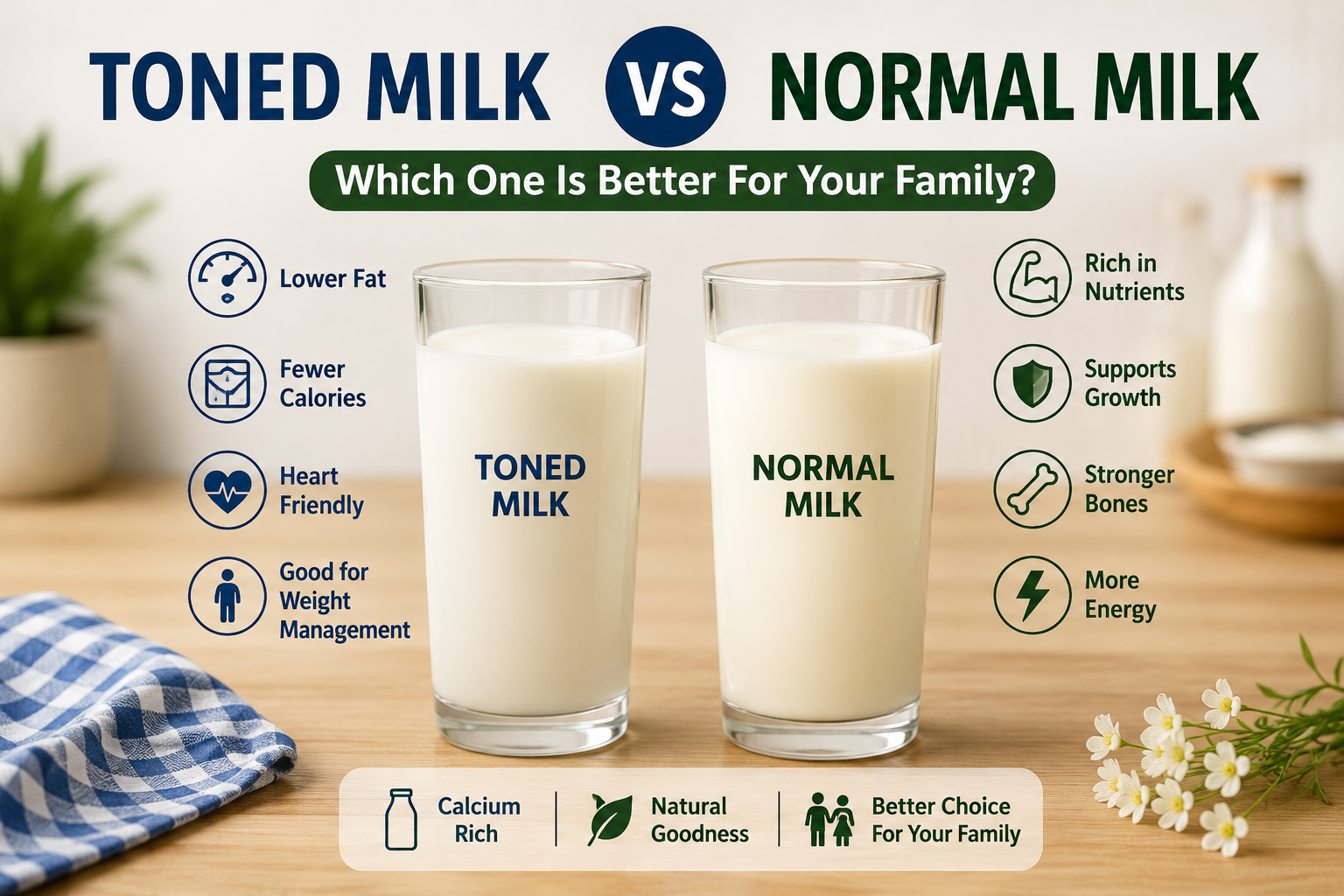

Quick answer: Toned milk is lower in fat and calories than full-cream milk, while both can provide similar amounts of protein and calcium. But “normal milk” is not a precise dairy category in India: it may mean full-cream, standardised, cow’s milk or buffalo milk. Check the fat and solids-not-fat (SNF) values on the pack before comparing.
The right choice depends on the person’s age, overall diet, health needs and the type of milk being compared. Toned milk is not automatically healthier for everyone, and full-cream milk is not automatically better for every child.
What is toned milk?
In India, toned milk is made by adjusting the fat content of milk, traditionally by adding skimmed milk and water to buffalo or mixed milk. Under the commonly used Indian standard, toned milk contains at least 3.0% milk fat and 8.5% SNF. SNF means the non-fat milk solids, including protein, lactose and minerals.
Toning reduces the fat and energy content while retaining much of the milk’s protein and minerals. The exact nutrition can vary by brand and product, so use the nutrition panel rather than assuming every carton is identical.
What does “normal milk” mean?
“Normal milk” is a household expression, not one fixed nutritional standard. A person may use it to mean untoned cow’s milk, buffalo milk, full-cream milk or simply the regular packet of milk they buy. These can have different fat levels.
For a fair comparison, identify the category printed on the packet. Common Indian categories include:
- Full-cream milk: at least 6.0% fat and 9.0% SNF.
- Standardised milk: at least 4.5% fat and 8.5% SNF.
- Toned milk: at least 3.0% fat and 8.5% SNF.
- Double-toned milk: at least 1.5% fat and 9.0% SNF.
These are minimum compositional standards; check the current label and applicable food regulations for the product you buy. Fresh cow’s or buffalo milk may not fit a simple “normal milk” comparison.
Toned milk vs full-cream milk: quick comparison
| Feature | Toned milk | Full-cream milk |
|---|---|---|
| Minimum milk fat under the Indian category standard | 3.0% | 6.0% |
| Minimum SNF | 8.5% | 9.0% |
| Calories | Usually lower because it has less fat | Usually higher because it has more fat |
| Protein | Generally similar per 100 ml | Generally similar per 100 ml |
| Calcium | Generally similar; check the label | Generally similar; check the label |
| Texture and taste | Lighter | Richer and creamier |
| Cooking | Works for everyday use | Often preferred for richer desserts and recipes |
Do not treat the figures above as a nutrition analysis for every brand. Actual energy, protein, calcium and vitamin values can vary. Compare products using the same serving size and the nutrition information printed on their packs.
Nutrition: what changes when milk is toned?
Fat and calories
The main difference is milk fat. Since fat provides energy, toned milk usually has fewer calories than full-cream milk. This can help an adult reduce calorie intake if milk is a regular part of their diet, but weight management depends on the overall eating pattern and activity level.
Protein
Milk protein is largely present in the non-fat portion. Toning generally leaves protein levels broadly similar, although the exact amount depends on the milk and brand. Read the per-100-ml values on the label.
Calcium and other minerals
Calcium and many other minerals are not removed simply by reducing the fat. The calcium content of toned and full-cream milk can therefore be broadly comparable, but it is best to compare the label rather than assume identical values.
Vitamins
Milk fat carries fat-soluble vitamins such as vitamins A and D. Their levels can differ between products, and some packaged milk is fortified. Check the ingredient list and nutrition panel for fortification; do not assume that every milk product has the same vitamin content.
Which milk is better for babies and children?
Age matters more than the label “toned” or “normal”. Cow’s milk should not be used as a baby’s main drink before 12 months. Breast milk or infant formula remains the main milk feed during the first year. Small amounts of pasteurised full-fat cow’s milk may be used in food from around 6 months as part of complementary feeding, where appropriate.
For children aged 12–24 months, many paediatric and public-health guidelines advise whole/full-fat milk unless a healthcare professional recommends a different option. This is because young children have high energy needs and need adequate dietary fat. The right choice should take account of growth, diet, weight pattern, allergies and medical history.
After age 2, the choice between toned and full-cream milk can be discussed in the context of the child’s overall diet and growth. Do not switch a toddler to low-fat milk solely to reduce calories without advice from the child’s paediatrician or dietitian.
Milk is only one part of a child’s diet. Offer age-appropriate meals with a variety of foods, and avoid letting large amounts of milk replace iron-rich foods.
Which milk should adults choose?
If you want to reduce saturated fat or calories
Toned milk may be a practical option because it generally contains less fat and fewer calories than full-cream milk. It is one small dietary choice, not a treatment for high cholesterol or heart disease. If you have a medical condition, follow the advice of your doctor or registered dietitian.
If you need more energy
Full-cream milk provides more calories per serving and may suit someone who needs additional energy or prefers its taste. It is not a substitute for a balanced diet, and it is not necessary for every adult.
If you are trying to lose weight
Toned milk can reduce calories compared with full-cream milk when the serving size is the same. The difference may be modest, so consider the whole diet, portion sizes, added sugar in tea or coffee, and physical activity.
If you are concerned about heart health
Toned milk generally has less total and saturated fat than full-cream milk. However, cardiovascular health depends on the overall pattern of food choices, physical activity, smoking, blood pressure, cholesterol and other factors. Ask your clinician for individual advice if you have raised cholesterol or heart disease.
What about double-toned and standardised milk?
Double-toned milk has a lower minimum fat content than toned milk, while standardised milk sits between toned and full-cream milk in fat content. They are different categories, not interchangeable names. Choose based on the product label and your nutritional needs rather than assuming that the lowest-fat option is always the best.
How to choose milk at the supermarket
- Read the category name: toned, double-toned, standardised or full-cream.
- Compare fat, protein, calories and calcium per 100 ml, not per differently sized serving.
- Check whether vitamins A and D are added and whether the product is pasteurised or UHT-treated.
- Check the use-by date, storage instructions and whether the pack is intact.
- Once opened, refrigerate and use the milk according to the manufacturer’s instructions.
- For infants and young children, choose according to age-specific feeding guidance and your paediatrician’s advice.
Common myths about toned milk
Myth 1: Toned milk has no nutrition
Not true. Toned milk still provides protein, calcium and other nutrients. Its defining difference is the lower fat content compared with higher-fat categories.
Myth 2: Toned milk has no calcium
Not true. Reducing milk fat does not mean that calcium is removed. Compare the calcium values on the labels of the products you are considering.
Myth 3: Full-cream milk is always best for children
Not for every age or every child. Babies under 12 months should not have cow’s milk as their main drink. For toddlers, whole milk is commonly recommended unless a clinician advises otherwise; older children’s needs depend on their overall diet and health.
Myth 4: Toned milk causes weight loss
No single food causes weight loss. Toned milk may provide fewer calories than full-cream milk, but weight change depends on total energy intake, activity, sleep, health and other factors.
So, which is better: toned milk or full-cream milk?
There is no one-size-fits-all winner. Toned milk is lower in fat and calories and may suit adults who prefer a lower-fat option. Full-cream milk provides more energy and may be appropriate for some young children and people with higher energy needs. For babies under 12 months, cow’s milk should not replace breast milk or infant formula as the main drink.
Most importantly, compare the actual milk categories and nutrition labels. “Normal milk” can mean different things, so a clear comparison starts with knowing whether the packet is full-cream, standardised, toned or double-toned.
Frequently asked questions
1. Is toned milk healthier than normal milk?
Neither is automatically healthier. Toned milk has less fat and usually fewer calories than full-cream milk. The better choice depends on age, dietary needs, health conditions and what “normal milk” means on the packet.
2. Can a 1-year-old drink toned milk?
Many guidelines recommend whole/full-fat milk for children aged 12–24 months unless a healthcare professional advises otherwise. Ask your child’s paediatrician before choosing a lower-fat milk.
3. Can babies below 1 year drink cow’s milk?
Cow’s milk should not be the main drink before 12 months. Breast milk or infant formula should remain the main milk feed. Small amounts of pasteurised cow’s milk may be used in foods from around 6 months where appropriate.
4. Does toned milk contain less protein?
Protein is generally similar in toned and full-cream milk, but the exact amount varies by product. Compare protein per 100 ml on the pack.
5. Does toned milk contain less calcium?
Not necessarily. Calcium is generally retained when fat is reduced, but values can vary. Check the nutrition panel for the exact product.
6. Is toned milk good for weight loss?
It can help reduce calorie intake compared with full-cream milk if you drink the same quantity. It does not cause weight loss by itself; overall diet and activity matter.
7. Is toned milk suitable for daily use?
For many adults and older children, pasteurised toned milk can be part of a balanced diet. Suitability for infants and toddlers is age-dependent, so follow child-feeding guidance.
8. Which milk is better for tea, coffee and Indian sweets?
Both can be used. Toned milk gives a lighter result, while full-cream milk usually gives a richer taste and texture for kheer, rabri, kulfi and similar recipes.
References and further reading
- Food Safety and Standards Authority of India (FSSAI) – food standards and consumer information.
- ICMR–National Institute of Nutrition – Dietary Guidelines for Indians.
- NHS: What to feed young children – guidance on milk and dairy by age.
- CDC: Cow’s milk and milk alternatives – guidance for infants and toddlers.
Medical disclaimer: This article provides general nutrition information and is not a substitute for individual medical advice. A paediatrician or qualified dietitian can advise on milk choices for a child’s age, growth, dietary pattern, allergy or health condition.