
Choosing a preschool is a big decision. The right environment can help a young child feel safe, build confidence, make friends and enjoy learning through play. But when every school advertises caring teachers, fun activities and a strong curriculum, how do you compare them?
Use this practical 15-point preschool checklist when researching schools, visiting campuses or speaking with admissions teams. It applies to families in India and elsewhere; admission rules, staff qualifications and licensing requirements vary by location, so always check your local education authority’s guidance.
Quick answer: What should you look for in a preschool?
Prioritise safety, warm and responsive teachers, clean facilities, age-appropriate play, manageable class sizes, clear communication with parents and transparent policies. A colourful building or long list of activities matters less than how children are treated throughout the day.
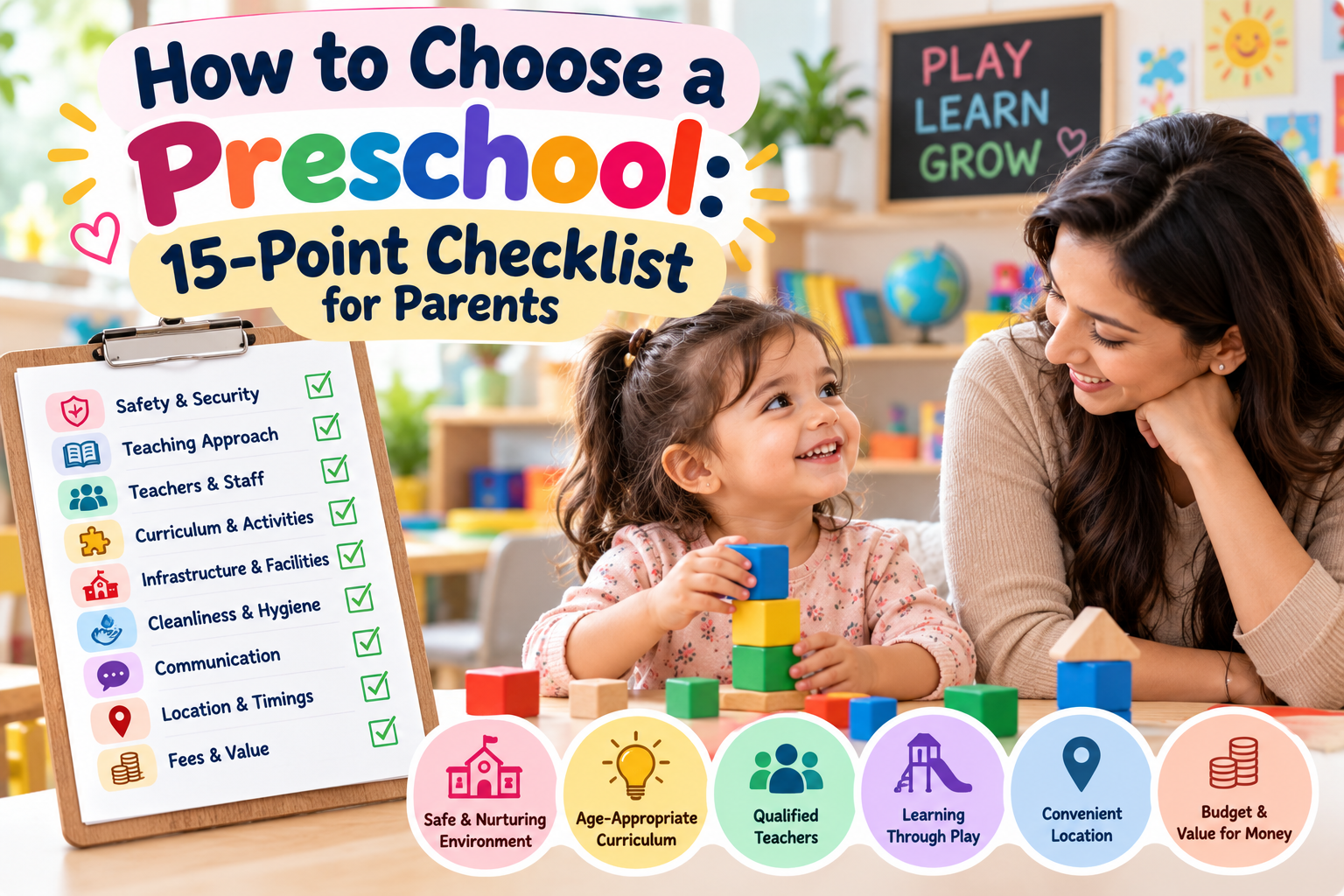
15-point preschool selection checklist
1. Check registration, recognition and local requirements
Ask which authority regulates or registers the preschool and whether its current approvals are available for parents to see. Requirements differ by country, state and type of centre. Verify claims with the relevant local authority rather than relying only on a brochure.
2. Observe how teachers interact with children
During your visit, notice whether adults speak respectfully, listen to children, get down to their level and respond patiently. Children should be guided without humiliation, threats or harsh punishment. Ask how staff handle crying, conflict and separation anxiety.
3. Ask about teacher qualifications and training
Find out what early-childhood education training teachers have completed, whether assistants receive training and how often staff update their skills. Ask whether there is a designated person responsible for first aid and emergencies.
4. Understand the teacher-to-child ratio
Ask how many children are assigned to each teacher in your child’s age group, including during arrival, outdoor play, meals and toileting. Also ask how the school manages staff breaks and absences. A ratio on paper is useful only if adequate supervision is maintained throughout the day.
5. Inspect entry, exit and visitor security
Check how children are signed in and released, who is authorised to collect them, how visitors are identified and whether gates are supervised. Ask what happens if an unfamiliar person arrives to collect a child.
6. Look closely at hygiene and child-friendly facilities
Notice whether toilets and handwashing areas are suitable for young children, whether drinking water is accessible and whether toys and frequently touched surfaces are cleaned. Ask how the school handles illness, nappy changes if relevant and food allergies.
7. Review indoor and outdoor safety
Look for secure play equipment, safe flooring, shaded outdoor areas and clear boundaries. Check that cleaning products, medicines, electrical points and small objects are kept out of children’s reach. Ask how playground equipment is inspected and maintained.
8. Understand the learning approach
Ask how the school balances free play, guided activities, stories, music, movement, art and early language or number experiences. For preschool-age children, learning should be developmentally appropriate and engaging rather than dominated by worksheets, long periods of sitting or pressure to memorise.
9. Ask for a sample daily routine
Request a typical timetable. It should include a sensible balance of play, rest, meals or snacks, outdoor time and transitions. Ask how the routine changes for younger children and how the school responds when a child needs extra rest or time to settle.
10. Find out how the school supports individual children
Children develop at different rates and may have different communication, sensory, mobility or learning needs. Ask how teachers adapt activities, communicate concerns and work with families or specialists when additional support may help.
11. Check food, drinking water and allergy procedures
If meals or snacks are provided, ask for the menu, food-preparation arrangements and policy for allergies, dietary restrictions and choking hazards. If children bring food from home, find out how lunch boxes are stored and how staff supervise mealtimes.
12. Ask about illness, medication and emergencies
Request written policies for fever, contagious illness, medication, injuries, emergency contacts and evacuation. Ask how parents are notified after an incident and whether staff practise emergency procedures.
13. Understand communication with parents
Ask how often teachers share updates, whether parent-teacher meetings are scheduled and whom you should contact with a concern. A school should be willing to explain a child’s day honestly, including difficulties as well as achievements.
14. Compare fees and the complete cost
Request a written fee breakdown covering registration, admission, tuition, meals, transport, uniforms, materials, activities, deposits and any annual charges. Ask about payment dates, refunds, notice periods and possible fee revisions. Compare the total cost, not just the advertised monthly fee.
15. Consider the commute and your child’s comfort
Estimate the journey at actual drop-off and pick-up times. Ask about transport supervision if you need a school bus or van. If possible, arrange an age-appropriate visit or settling-in session and observe whether your child gradually feels comfortable in the environment.
Questions to ask during a preschool visit
- What are the qualifications and experience of the teachers in this age group?
- How many children are there per teacher, and how is supervision maintained?
- What does a normal day look like?
- How do you help children who cry or take time to settle?
- How do you manage toileting, handwashing and hygiene?
- What is your procedure for injuries, illness and emergencies?
- How do you handle food allergies and dietary needs?
- How do you communicate a child’s progress or concerns?
- Can parents review the written safety, discipline and fee policies?
- What is included in the fee, and what costs extra?
Red flags to take seriously
- Staff refuse to explain safety, discipline or child-release procedures.
- You see children left unsupervised or adults speaking to them harshly.
- The school will not explain staff qualifications or who is responsible for children.
- Toilets, play areas or food-handling spaces appear unhygienic or unsafe.
- There is no clear process for contacting parents after an injury or emergency.
- Fees, extra charges or refund rules are unclear or only explained verbally.
- The school promises guaranteed academic results for very young children or relies heavily on pressure and long worksheet sessions.
One concern does not automatically tell the whole story. Ask for an explanation, request to see the relevant written policy and compare what you are told with what you observe.
Preschool checklist: A simple scorecard
After visiting each school, rate these areas from 1 (needs improvement) to 5 (excellent). Write down examples rather than relying only on a first impression.
| What to compare | School A | School B | School C |
|---|---|---|---|
| Safety and child release | __/5 | __/5 | __/5 |
| Teacher warmth and training | __/5 | __/5 | __/5 |
| Supervision and class size | __/5 | __/5 | __/5 |
| Cleanliness and facilities | __/5 | __/5 | __/5 |
| Play-based learning and routine | __/5 | __/5 | __/5 |
| Parent communication | __/5 | __/5 | __/5 |
| Fees and commute | __/5 | __/5 | __/5 |
Do not let a high total score cancel out a serious safety concern. Treat safety, supervision and respectful care as essential requirements.
When should you start looking for a preschool?
Start researching several months before your preferred joining date if local schools have application windows or limited places. Check each school’s age eligibility, application dates, documents and settling-in process directly. There is no single admission calendar or age rule that applies everywhere.
Does your child need to know letters and numbers before preschool?
Usually, the more useful preparation is helping your child practise everyday skills in a relaxed way: communicating basic needs, listening to a short story, playing alongside other children, washing hands with help and becoming familiar with simple routines. Children do not need to master reading or formal worksheets before starting preschool. Ask the school what it expects from children entering that particular class.
Frequently asked questions
What is the most important factor when choosing a preschool?
Start with safety and the quality of care. Look for attentive, respectful teachers, reliable supervision, clean facilities and a developmentally appropriate daily routine.
How many preschools should parents visit?
If practical, compare at least two or three schools. Visiting more than one helps you assess differences in teacher interaction, safety, routines, commute and total fees.
Should I choose a preschool close to home?
A shorter commute can make daily transitions easier, but distance should be weighed alongside safety, staff quality, learning approach and your child’s comfort.
Is play-based learning important in preschool?
Play gives young children opportunities to explore, communicate, move, imagine and practise social skills. Ask how play is included in the actual daily routine rather than relying only on the school’s description of its curriculum.
What documents are usually needed for preschool admission?
Schools may request an application form, child’s birth or age proof, photographs, parent contact details and medical or emergency information. Requirements vary, so obtain the current list directly from the school.
Related MomSaathi guides
- First Day of Preschool: Tips for Parents
- Karnataka LKG and UKG Admission Guide
- Learning Activities for 4-Year-Olds
Final thoughts
The best preschool is not necessarily the one with the biggest campus, most expensive facilities or most impressive advertisements. It is the place where your child is safe, respected, understood and given time to learn through meaningful experiences. Visit in person, ask direct questions, read the policies and trust what you observe. Use this checklist to compare schools calmly and choose the environment that fits your child and family.